Friday, March 16, 2012

Flat Top Cruiser: The Legacy of the Gibson Les Paul Junior


Tailfins, hair grease, B-Movie Sci-Fi, Kerouac, Elvis, James Dean. I love the 1950s. It's my favorite era of American history, and one that produced an absolute overload of groundbreaking movies, music, literature, fashion, ideology, design and style.

In the world of guitars, the 1950s era still looms largest. The innovations that blasted onto the still new and untested electric guitar field in that decade are still the biggest leaps forward made in the guitar business. The Fender Telecaster, Stratocaster and Precision (the first electric bass guitar) were all invented in the 1950s and are still made, virtually unchanged in design, to this very day, 60 years later. Ditto for Kalamazoo, Michigan's Gibson Guitars,who had been in the guitar business since the 1800s. Gibson is world famous in perpetuity for Gibson Les Paul, SG, ES-175, ES-295, The Byrdland,and my absolute favorite guitar of all time, the glorious Gibson Les Paul Junior line of guitars, which includes all variations of the Melody Maker, Les Paul Special, and Les Paul Junior.


The original single cutaway Junior was developed when Gibson saw the need to compete in the lower end electric guitar market, as Fender's Telecaster as well as several other guitars made by upstart companies were selling huge numbers in the wake of the first appearance of rock and roll music on the mainstream national scene in 1954. Gibson knew that in order to compete in this market they needed an affordable but high quality instrument that would appeal to young rock and rollers and student guitarists. They looked to basically develop their own version of the Fender Esquire (the single pick up version of the Telecaster) but price it even lower.

So the LP Junior was born. A slab of mahogany for the body, another for the neck, a rosewood fretboard, a single P-90 pick up, and a simple, brutal bar of metal for the bridge. It was initially finished in two colors. One, introduced in 1954, was a gorgeous tobacco sunburst, like Leo Fender's first Stratocasters. The other, which appeared the following year, was a limed mahogany, called "TV Yellow" by Gibson's marketing wizards. Some say that this finish was called "TV" because it was meant to "look good on television". The real reason was the Fender Telecaster. The buttery yellow color, which ranged on different guitars from a dark mustard tint to a full on screaming banana yellow, was meant to compete with Leo Fender's early butterscotch Teles.

The Junior was similar in shape to Gibson's popular Les Paul series of guitars, but without the extra frills, carved cap and aesthetic pleasantries that made the LP a more expensive guitar. There was no drop in quality here. This was a well made, solid as a rock and virtually indestructible guitar with a bright, full throat-ed sound that was surprisingly versatile for only having the one pickup, one volume, and one tone in it's electronic circuit.

The guitar was almost immediately Gibsons' biggest selling electric. Students, young kids, and even old pros gravitated to this guitars' combination of low price point and high quality. The guitar sold for $99.00 dollars in 1954, as opposed to the Les Paul Standard which went for just over $200. Funnily enough, if you'd like to buy a vintage, original LP Junior from 1954 in good condition, you should be prepared to shell out upwards of $5,000.


Four years later, Gibson decided to up the ante with it's double cutaway version of the LP Junior, which for a time replaced the classic single cut. These are highly sought after guitars, mostly because of the punk rock guitarists who began buying them in pawnshops and used guitar stores in droves in the late 70s, in emulation of the NY Dolls Johnny Thunders, who famously played one.


In 1955, Gibson also introduced the LP Special, a two pickup version of the Junior which sold for slightly more, and was meant to be an upgrade, or a gateway guitar to a more upscale LP Standard or Custom. This too was a popular and fantastic guitar, available in single cut in 1955 and double cutaway by 1958. Original LP Specials, depending on condition, can fetch as high as $30,000. on the collector's market now.


In 1959, diminishing guitar sales prompted Gibson to introduce an even more affordable, even more stripped down, even more Fender-sounding instrument: The glorious Melody Maker. This guitar had an even thinner mahogany body, a slimmer headstock, and an option of one or two very Stratocaster-like pickups. A double cutaway version was introduced a bit later.


In 1961, the Junior line was revitalized with a new shape, similar to Gibson's newest offering, the SG, (or "Special Guitar", not to be confused with the Les Paul Special, an entirely different beast). This shape actually replaced the original LP Junior shapes, as the SG replaced the Les Paul. By the 1970s, interest in vintage Gibsons prompted the company to begin to re-issue all of the various shapes. At present all of these variations are being produced by the Gibson Company. At the time though, Gibson was very concerned with staying fresh and changing their guitar line completely every few years. New designs were not added to old ones, they were introduced to completely replace them.


Gibson's re-issue series were not, initially, period-correct replicas. They were new versions of the old guitars, with modern conveniences such as Grover tuners and Tune-o-Matic bridges. They were also offered in finishes not on offer for specific models back in the 50s and 60s. These early re-issues are also prized collector's items in the present day and are highly sought after at price points just a bit below the originals. Some purists bemoaned the modern "upgrades", but aesthetically these re-issues were a welcome blast from the past and at least a partial return to what used to be known as "Gibson Quality".

They also saved Gibson from losing sales of new guitars, as it was clear that most players would rather buy the old designs. By creating new versions of the classics sold at a cheaper price than the highly sought after, collectable originals, Gibson was able to capitalize on the reputation of their older guitars (see '75 LP Special advert below). Later, Gibson's Epiphone line started producing even more affordable versions of these guitars with the Epiphone headstock in place of the Gibson "open" book shape. These were produced in China and varied greatly in quality from guitar to guitar.


My own love of LP Juniors started with my early worship of Mr. Johnny Thunders. The tragic NY Dolls/Heartbreakers guitarist rarely played anything but a '58 double cut TV Junior and I wanted one badly. This really started my obsession. The first one I got was a black Epiphone singlecut Junior, with a bolt on neck and P-90. this was around 1998, and I played this guitar on most of my band's (Dimestore Haloes) releases and live shows in this era. It was not a bad little guitar. I wasn't psyched with the Epiphone headstock and bolt on neck, but it sounded great and held up well on stage and in studio. Below is a pic of me holding the guitar onstage with the Dimestore Haloes in 1999.


I bought a double cutaway TV Yellow Epiphone Junior around a year later as a backup guitar, and this guitar looked amazing, but the neck was a piece of crap, the pickup sounded thin and weird and I soon traded it in on what was to be my favorite all time guitar (see pic below). It was a 2001 single cutaway, sunburst LP Junior, a 1955 re-issue. This guitar was just disgusting, it was so great. The finest guitar I have ever owned. I played it onstage and in the studio during the recording of the Haloes' last album, "The Ghosts of Saturday Night", and it was the only guitar on my 2005 solo disc, "Amazing Graceless", despite the fact that I'm holding a Grestch on the cover and an LP Special DC on the inside panel.


In 2004 I bought the aforementioned 2002 TV Yellow DC LP Special. It was a great guitar, but had a much mellower sound than my '55 reissue Junior. Much less biting and throaty and much more fat and warm.

Because I am an idiot, I sold both of these guitars in 2006. Traded them in on a 2005 Gibson SG with classic brown leather case. This was a nice guitar, but a bad decision. It wasn't long before I needed the money and sold that, too. I had a 1954 Reissue Fender Strat in daphne blue at that time, and a couple of Gretsch Electromatics. Which I also sold eventually. I've owned well over 50 guitars in the last ten years. None of them has been as perfect for me as that '55 reissue LP Junior.

I've also owned several LP Junior copies. One by Dillion, which was a great copy of a late 50s cherry double cutaway Junior. I put a Bigsby on that and it was even cooler. See an earlier blog here for pics of that guitar and a rundown on that process. I ended up selling that guitar to Tim from the Hormones, who has the same guitar acquiring/selling disease that I have. He, of course, sold it. It was a great little axe.

I also had a Melody Maker/ Junior combo copy by Agile, who import pretty good quality chinese guitars. It was a good little axe and they actually still used my review of it on their website until recently. I've also had a re-issue 1959 Melody Maker, in worn white. Also a groovy guitar, and also one that I should have held on to. I have also owned an Epiphone Custom Shop TV Yellow '55 Junior re-issue, and an Epiphone Custom Shop LP Special re-issue. Both really, really great slabs o' wood. Of course, I sold them eventually. I also seem to recall a Xaviere Lp Junior singlecut copy in cherry sunburst that I had for about three days before I traded it in. It, unfortunately, was a fresh piece of elephant dung.

Speaking of holding on to things, I'm keeping this one (pic below). It is a rare bird of sorts, a real sleeper, and a guitar that is pretty much perfect for my needs.

In 2003, Gibson re-issued the Melody Maker, but with a difference. They took the Melody Maker's super thin slab body and thinner headstock, and coupled it with a hot p-90 Les Paul Junior pickup, thick, chunky 50s style neck, TV finish and newer LP style tune-o-matic bridge. This became the Les Paul Melody Maker Junior, an amazing hybrid that was sold from 2003-2006. They went for about $500. in 2003, and used ones are still fetching that price now, nine years later. I managed to score mine on eBay for around $475. It sounds and feels amazing.


Many players don't like the "worn" or "satin" finishes that Gibson produces these days, but I actually do. Every guitar that I've had with this finish was louder, brighter and felt better under my hands than sticky, thick nitro finish jobs.

Gibson began using this finish for a couple of reasons. One, it is cheaper to produce than their traditional thick, glossy finish jobs, and can bring the price point of a great guitar down enough so that a regular joe like me can afford it. Number two, it resembles the worn away, time-thinned, broken in finish of a real vintage, 60 year old guitar. Not exactly, but close. Purists will tell you that this is blasphemy, but I'm not a purist. And the way this satin finish allows the wood to breathe and brings out the tone of the instrument is so awesome that I can't argue with it. In fact, Gibby now uses this finish on all of their mid-price Melody makers, LP Juniors, LP Specials, SGs, etc. And while it's said that the satin finish doesn't last as long or wear as well, you'll be able to afford to re-finish it down the line if needed.

Thanks for reading my very personal and subjective account of the legacy of the LP Junior. These are beautiful and sonically superior guitars, and every guitar geek should own at least one. Collect them, drool over them, admire them, buy them, sell them, but most of all, PLAY 'em.

Saturday, February 25, 2012

Living In The Past: Why Retro?


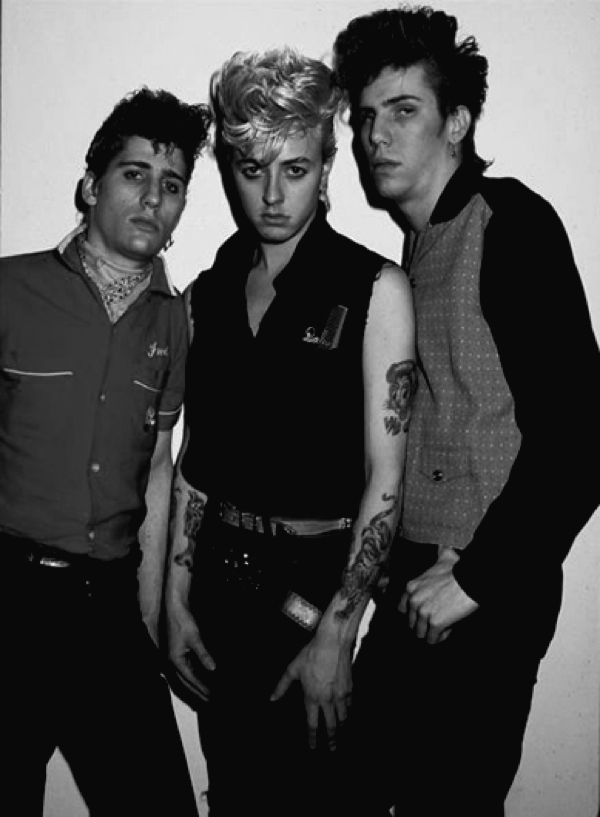
When I was 12 or 13 years old, I listened to (and taped everything off of) the radio. Everything. I loved music. I loved how it took me outside of the tiny Western Michigan town that I lived in and promised a world that I knew I wanted but couldn't even conceive of. At that time, I had no idea of what genres I preferred or what type of music I liked. I wanted everything. This was in the early 80s, so the songs i taped off the radio were pretty much what you'd expect. "Come On Eileen", "Sweet Dreams are Made of This", "Tainted Love", "Do You Really Want To Hurt Me", "Every Breath You Take", "Jessie's Girl", "Private Eyes", etc. But there was one song that always made my tapes that struck me in a wholly different way. It was called "Sexy And 17" by a group called the Stray Cats. That song was something else entirely.

Even at my young age, with my untutored musical ear, I could tell this song sounded nothing like the rest. And I saw pictures of the band in my rock magazines that I'd started collecting. They looked a little like the other bands of the time. Duran Duran, Soft Cell, etc. all had members with high hair and leather jackets, but there was something different about these Stray Cats guys. They sort of reminded me of Elvis, whom my mother loved, a young Johnny Cash, who my father loved, and the movie Grease, which my mother and sisters loved. They also reminded me of the Sunday afternoon infomercials I'd seen on TV. We only got three channels where I lived, no cable, no MTV ( a new music channel that I wouldn't actually see for another couple of years), so whatever was on, we watched. Sunday afternoons there was always this commercial for a huge set of vinyl records by Time Life called something like "The Golden Hits Of The Fifties". I absolutely loved the songs they'd play, and the grainy black and white video clips they'd show of the performers. These people looked like they were from Mars to me. I also remember that my Mom would sometimes sing along to some of the songs. I was amazed that she had ever had anything to do with anything this cool. My Dad even bought me a Chuck Berry tape at a truck stop one day, trying to get me into the real stuff. It didn't really work. Not yet.


After awhile I'd collected all the Stray Cats' hit songs on a tape: "Rock This Town", "I Won't Stand In Your Way", "Stray Cat Strut". Like a lot of things when you're that age though, my Stray Cats love sort of faded. I got into Def Leppard and Motley Crue and Ozzy and all the other hard rock stuff of the day, like every other kid my age. Predictably, I grew my hair long and bought a pointy guitar. But not for long.

By the time I was 25, I was a full fledged music obsessive. I had become pretty decent on the guitar, collected hundreds if not thousands of records, tapes and CDs, played in several bands, and moved to the big city (Boston) to "make it". I had grown out of hard rock and delved deeply into the world of punk rock. I had become obsessed, utterly with another favorite band. One who would inform my musical tastes and change my life, my hairstyle, the types of guitars I played, my politics, the movies I watched, the books I read, my morality, my clothes...I'm talking about the only band that matters. The Clash.


In reading about and obsessing over everything that Joe, Paul, Mick and Topper had ever done, I ran into a few words that excited me and sent my young imagination afire. "Rockabilly", "Quiff haircuts", "pompadour", and I said aloud as I read, in hushed and reverent tones, the names of the saints: "Gene Vincent". "Eddie Cochran". "Chuck Berry". The Clash also got me into Ska, reggae, pub rock and Kerouac, but that's another story.

I started wearing an old raggedy bowling shirt, cheap fake doc martens, and combing my hair into a huge dyed black pompadour. Construction workers would point at me and laugh as I walked the streets, shouting "hey Elvis!", snickering into their greasy Burger King lunches. I knew I was on to something.


The other band that I was excited about at that time was Social Distortion. This is the band that really re-ignited an obsession with the rebel rock of the past, in the consciousness of Gen-X punk rock types like myself. Mike Ness and co covered Johnny Cash, greased their hair, played vintage instruments, and acted tough and bad ass in that time honored 1950s way. I loved them, still do.


My own band at that time (mid 90s), the Dimestore Haloes, made records and toured and were fairly well known in punk circles for adding, like the Clash, The Cramps, and Social D. did in various ways, that 50s aesthetic to three chord, fast punk rock. Lots of bands did this at the time, and I wish more did today. I'd probably be more interested in modern punk if the kids still had a clue.


In the 90s I also discovered something that would further drive home and inform my 1950s /1960s obsession. Norton Records and Kicks! Magazine. The irreverent, hilarious, intelligent and informed writing in the mag, and the music put out on the record label (both owned by Billy Miller and his wife Miriam Linna)was, and still is, perfect. The mag no longer exists, and good luck finding copies, but the label is still going strong.

Unlike other phases in my life, the love of the 40s, 50s and early 60s never went away. I'm 41 now, and more obsessed with learning about those eras than ever. I own a 1954 kitchen table and chairs, as well as a '50s coffee table. My wife and I go to antique and vintage stores every chance we get,looking for old records, toys, photos,clothes, just to see them if we can't take them home.

I can't afford tons of expensive antiques (and '50s stuff is remarkably pricey), but if anything looks remotely mid century I want it. I buy new guitars and modify them to look like old ones. I watch black and white movies and read books by 1950s writers. I go to a 1950s style barber shop to get my hair cut. I obsess over Elvis, Sun Records, Meteor and Starday releases, Hank Williams. Link Wray, Esquerita, Howlin' Wolf. Old cars, old motorcycles that I'll probably never be able to afford.


I'm not a collector, I'm not an antiques dealer or mid century historian. I just want the feeling. I know you can't buy it or own it. I just want to touch it. The past. It's a different world. Cars were works of art, clothes were durable, comfortable and stylish. There were new innovations in design, art, and politics as well as music, movies and literature. Tradition was still respected. It was not a perfect world, I know. But it's a world that we've lost entirely in this age of technology, instant gratification and moral decline. Those old movies, records and ideas aren't dated or boring to me. Those days jump off the screen and come alive.


There is, for the vintage obsessive, also the feeling that we'll never quite touch the object or idea that we love. We can't know what it was to be alive back then, because we weren't, or if we were, we were too young to remember much. I totally admit, however, that if I woke up tomorrow morning suddenly transported back to the 50s, I'd probably be extremely annoyed at not being able to use my cell phone, and having to actually drive into town to check out that new Carl Perkins or Billy Lee Riley or Little Richard 45, instead of just punching it in on eBay and having it sent to my home, or failing that, just downloading it. I know I've romanticized a period that will never return and is wholly gone, and I do so because it seems to suit my personal aesthetics more than the time I actually live in.


Nevertheless the obsession remains. I guess some guys watch football, some guys play video games, some guys work out and wax their armpits, I hang out in antique stores, make new guitars look old, and read enough books on Elvis to numb the very mind and ass of the average person. I own three books about Eddie Cochran. Three. One, apparently, was not going to cut it. I buy every worthless repro 1950s toy I find in novelty stores. Doesn't matter if it's reproduction. It looks right. It's cheaper and in better shape. I get that feeling from it. That's what I'm after. At this point, I've been into this for well over 20 years. The interest has never really waned, and I hope it never does.

Monday, December 26, 2011

In Defense Of The Fender Stratocaster......


Conventional rock and roll wisdom says that a Strat is not a "rock" guitar. It is a "funk" guitar, it is a "soul" guitar, it is a "blues" guitar. But for Rockabilly? No, that's a Gretsch. For Punk Rock? No, that's a Les Paul Junior. For Metal? No, that's something pointy with too many frets. For Country? No, that's a Telecaster.

As for me, it took me a long time to come around to the ways of Strat-love. I even refused to let a great guitarist join my old band on the grounds that he played a Strat. I hated them with a passion. I was wrong, people.

Why do us "rocker" types hate Strats so much? I believe the reason is threefold:

REASON NUMERO UNO- "The terrible, awful people who have famously played Strats." It all starts with a very overrated man named Eric Clapton. He was great in his early years, when he played Les Pauls, SGs, Teles, 335s, etc. But as soon as he fell under the spell of the Stratocaster, it was all over. He not only came to epitomize the Strat player, he came to epitomize watered down, shitty white blues music. Terrible crimes he committed against his blues/rock roots, all the while clutching a black Strat in his puffy hands and making a queasy expression that most people thought meant he was a kindly British rock star having a good old time.Of course, that grimace of puke to come really signifies a deep, horrible self knowledge. This knowledge comes after you have sold out your high minded ideals for a steady and massively huge paycheck and a couple rolls in the hay with George Harrison's wife. This often comes with the realization that your playing has become trite, obvious and boring. Because this brings you millions of dollars, you will not seek to change this. But forever will you suffer the guilt and shame.

ERIC CLAPTON IS NOT FIT TO WAX THE LARGE, BLACK BALLS OF MUDDY WATERS. It has to be said.


(LEFT: The great Buddy Holly.) So who, besides Clapton, ruined the Strat for us all? Well, a man named Stevie Ray Vaughan really made the Strat the horridly common instrument it is today. Stevie was actually a really great guitarist who played with soul and grit and real blues feeling. He sold all those qualities to a major label in order to be more like his hero Eric Clapton, then he cacked it in a helicopter, thereby leaving us a couple listenable records, along with some dreck. At least he spared us the further crimes against rock and roll he was most likely about to commit with his trademark beat up 60s Strat. I'd like to think he would have eventually wised up and gone underground, becoming a fixture on the chitlin circuit and shunning the garish MTV spotlight. I'm a fan, sadly, and that's a fan's wishful thinking. Other Strat-ruiners: Mark Knopfler of Dire Straits, Billie Joe Armstrong of Green Day (now busy ruining the LP Junior for us all), U2's constipated martini bar waiter "The Edge", and lots, lots more, including frog faced frat boy John Mayer and retarded Allman Brother Johnny Lang.

REASON NUMERO DOS that we hate the Strat: "It's too common." Yes, the Strat is the highest selling guitar of all time, and the most copied. More guitars resemble a Strat than any other guitar shape. Almost every guitar maker, large and small, have Strat like guitars. Even Gibson, who recently bought the Charvel company (who were very famous in the 80s for making really gaudy modernized Strat copies, which led to the coining of the term "Superstrat"). Only the Les Paul guitar shape is as close to being as recognizable and constantly copied.


(Left: The great Dave Alvin and his well worn 60s Strat.)
REASON NUMERO TRES: "They sound so thin and wimpy." The Stratocaster, like the Telecaster before it, was developed with single coil pickups, the latest in technology in 1954 when it was designed. These pickups are capable of a wide variety of sounds, but they do favor the cutting, thin, high end treble side of tone. This guitar was developed for playing early country music and western swing, like the Telecaster, as these were Leo Fender's favorite musics. Compared to slightly later technology developed by Gibson and Grestch in the form of "humbucking" pickups, they are also kind of buzzy and noisy when plugged into a cranked amp. Humbucking pickups eliminate the buzz, but also eliminate the high, keening wail of an original Strat bridge pickup.

I will now address each of those concerns, proving once and for all that the Stratocaster is the ultimate rock and roll guitar.

1) Famous Strat players: Yes, hacks like Eric Clapton are associated with the Strat. Guess who else played one? Buddy Holly was the first well known Strat player. Buddy revolutionized pop music in the mid fifties, wrote his own songs, dressed sharp, and was rarely seen without his trademark mid fifties sunburst Strat. In fact, he owned several, and outside of acoustics, was never seen playing a Gibson.


ROCKABILLY AND SURF MUSIC: Other rockabilly players besides the great Buddy Holly, favored strats. Ronnie Dawson, of "Action Packed" and "Rockin Bones" fame, always played one. So did Johnny Meeks from Gene Vincent and the Bluecaps. As did Roland Janes, who played on Sun Records sessions by Jerry Lee, Billy Lee Riley, Charlie Rich and more. Sonny Burgess and James Burton have been seen with Strats, as well. Dave Alvin of the Blasters and Jimmie Vaughan (yes, Stevies' bro) have been seen playing nothing but Strats for their blues/country/RnB based musics in modern times. As for the Surf? The Ventures, the Shadows, The Trashmen, Dick Dale. These giants of reverb and tremolo all played Strats. The hollow twang of surf music would not have existed without the Stratocaster. Even the Beatles played Strats on several cuts on "Rubber Soul" and "Revolver". Here are the Shadows with Cliff Richard defining 60s Brit Pop. Shadows guitarist Hank Marvin had the first Strat in Britain and his guitar heroics on said bright red Strat began the UK's enduring love affair with the electric guitar.


(At left, the Shadows rock out on matching Strats.)
Another Strat hero was Jimi Hendrix. Probably the most famous guitarist of all time, and the most famous Strat player. He sold more Strats than all the guitar salesmen on the planet, just by making it his instrument of choice. He liked Strats because Buddy Guy and Ike Turner did. That's right, Ike Turner. Perhaps one of the earliest bad ass guitar heroes, Ike stuck pretty close to his Strat collection for the entirety of his career. He beat his women and he beat his guitars, but both seemed to do alright for themselves afterward.


(Check the pic on the right to see Ike and Tina and their 1950s Strat.) Brother Wayne Kramer from Michigan Proto Punks the MC5 played a Strat quite often in his heyday (and today), as did his counterpart Ron Asheton from the amazing Stooges. Yep, that's a Stratocaster being flogged on such ballsy rock epics as "Kick Out The Jams", "Down On The Street" and "TV Eye".


That's Ron Asheton looking superemely cool with his late 50s Strat. But surely a Strat is no good for Punk music, one says? Hmm. How about Bob Andrews from Generation X, who used one more often than not? How about Robert Quine from Richard Hell and the Voidoids, who rarely played anything but a Strat? What about the brilliant Ruts guitarist Paul Fox? He was a Strat player.


Here's Bob from Gen X reminding you that punks played Strats in 1977.
What about heavy metal? Surely the shrill, quacking Strat sound couldn't keep up with the balls out punch of a metal riff? I'm not sure my favorite metal guitar player, the human riff factory that is Fast Eddie Clarke of Motorhead and Fastway, would agree. See below.


Sticking up for Strats in metal would also be... Richie Blackmore, Yngwie Malmsteen,Eddie Van Halen, and ...oh, just every guitarist in Iron Maiden, plus Steve Harris, who plays a Fender Precision. That's the Bass version of the Strat, for those keeping score at home. Witness:


I think I've just about wiped away that image from your mind, right? The one where you picture Eric Clapton's unfortunate weasel face grimacing in bowel-constricted agony as he plays another one of his cliche ridden, ham fingered solos while the world's most boring audiences cheer him on listlessly? Just take another look if you need to, while the rest of us move on to...

COUNTRY MUSIC. Although the Strat is now widely associated with blues and blues rock, and the Telecaster is universally known as "the country guitar, the Strat itself was originally designed for country players, by country players and one particular country fan by the name of Leo Fender. Here's the one man who, besides Mr Fender, contributed most to the perfect functionality and design of the Stratocaster.


That's Bill Carson, who played amazingly hot guitar licks for country music legend Hank Thompson's band, the Brazos Valley Boys, in "Country Music California" in the early 1950s. For those of you who don't know, Cali was once second only to Tennessee as the leading state providing country music to the hungry masses, back when the hungry masses had taste. That was a long time ago. Bill here was also a close friend of Leo Fender, and that Strat he's holding there is one of the first few ever made. Lep gave Bill a strat to test out onstage, and Bill's carefully worded opinion on the instrument contains many of the ideas we now associate with every Stratocaster. He was key in developing the instrument's wide variety of sounds and it's curvaceous and comfortable body shape.

Now that you've realized that just as many Strat players have rocked the ballsy riffs as Les Paul players, let's move on to reason number two: "The Strat is just too common".

Well, that one is true. Many guitarists like to consider themselves different, and will thusly play weird or obscure or highly customized guitars to stand out from the pack, who mostly play the two most popular guitars, the Strat (in its many variations) and the Les Paul (which also exists in many variations).

I used to think this as well. Then I played a Les Paul, and I played a Strat. They may be common, but there's a reason: They have not been beatn in design or functionality yet. Nor have they been beaten in beauty or tone or versatility. You see alot of Rockabilly guitarists playing Gretsches, but not many (if any) metal players. The Strat, however, is comfortable on metal stages, rockabilly stages, punk stages, country stages...just about any form of music. It really is a case of Guitar Darwinism. The best guitars will win. Strats and Les Pauls really are the best. And they have been since the early 1950s when they were designed. What other 1950s technology do we still use today? So yes, the Strat is common. Because it's the best.

Now we come to reason number three: "The Strat is too thin and wimpy sounding." Hmm. Perhaps the following clip, made with a stock late 60s Strat, with no pickup modifications at all, will make you question that widely held opinion?


And then there's the best thing about the Strat: it's ability to be easily modified. Strats are the ultimate DIY "hot rodding" platform. You can do anything you want with a Strat, because Leo Fender designed it to be that way. He wanted a guitar you could take apart, easily service, easily modify and personalize. And in designing this, he designed the ultimate guitar. The most comfortable to play, the guitar possessing the widest variety of sounds, the best looking guitar.

One of the many ways players have modified the Strat concerns it's "wimpy" or "thin" bridge pickup tone. Just as an aside, the bridge pickup on a Strat can indeed sometimes be thin and glassy. However, if a player just switches the pickup selector to the neck and middle pickups, one discovers a huge, thick, overwhelmingly grungy and dirty tone, with a cranked amp. If this is still not loud and aggressive enough for you, many players, such as fast Eddie Clarke, Eddie VH, Billie Joe from Green Day, some of the Iron Maiden guys, etc etc have opted to switch their Strat's single coil brisge pickup out for a double coil humbucker. This will fatten up that razor sharp, blade thin Strat sound, giving you the best of both worlds in one guitar (Gibson and Fender tones). Some Strat players say this is sacrilege and spoils both the original look and sound of the guitar, but I say have at it. Strats are for personalizing and playing. They were part of one man's search for the perfect multi function proletariat guitar back in the 1950s, and like the 1950s hot rod cars they were built to resemble, they exist for the driver/player to modify, customize and personalize. See the guitar below, which would be suitable for pretty much any kind of music the world has to offer.


In short, the Strat is both the world's most popular and most undervalued instrument. It looks great, sounds great and feels great. If you need other sounds, the Strat can take on new personalities with just some simple modifications. There's very little a Strat cannot do, and just about nothing a Strat hasn't done, from Rockabilly to grunge to pop to punk to RnB to soul to metal. Where there is guitar noise, there is likely a Strat. Don't hate, celebrate.

To the right is my newest guitar, a Lake Placid Blue 60s style Strat. I'm going to do some mods to it that I will talk about in later Blogs, I'm sure. Hope you enjoyed my Strat rant, and hope it changed your mind a little bit about the perfect versatility of a Stratocaster. And let's remember, it's not what guitar you play, but what you play on that guitar, that counts.